But as we move through 2026, a quiet revolution is happening under the hood of mainstream consumer tech. Welcome to the era of agentic AI.
We are officially transitioning away from passive tools and moving toward autonomous artificial intelligence assistants. These aren’t just software programs that write poetry or generate generic code on command; these are digital entities designed to execute multi-step workflows, make independent decisions, and complete complex tasks on your behalf while you focus on the bigger picture.
So, what exactly is agentic AI, and how is it already beginning to cross things off your daily to-do list? Let’s pull back the curtain.
The Core Difference: From “Typewriter” to “Manager”
To understand why this shift matters, we have to look at how we look at efficiency. Standard software requires constant hand-holding. If you want to launch a small business marketing campaign, you traditionally have to prompt an AI for ideas, manually copy those ideas into a document, write the emails yourself, and then schedule them one by one.
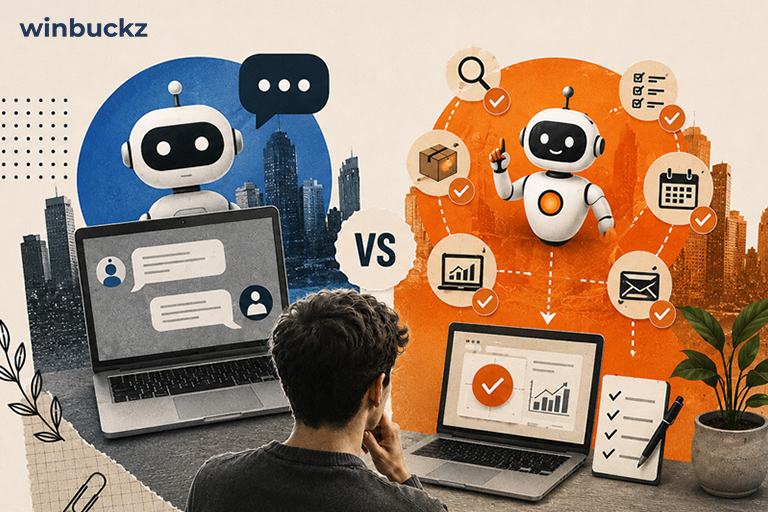
Unlike those early generative tools, agentic AI possesses a genuine sense of “agency.” Instead of managing individual steps, you simply give the system a high-level goal. For instance, you might say: “Analyze last month’s sales, find the three underperforming items, and launch a targeted email discount for them.” The system doesn’t just give you a text response; it acts. It evaluates the data, designs the assets, builds the timeline, and executes the campaign. This evolution in ai task automation means human creators are moving away from doing the tedious grunt work and stepping into the role of an editor or director.
1. The Autonomous Workspace: Powered by Google
When we look at how tech ecosystems are deploying this autonomy, Google is leading the charge by turning your everyday workspace into a self-operating engine.
Through the continuous integration of Google Gemini AI, your documents and spreadsheets are no longer just digital paper. Instead of a user manually digging through messy email threads to construct a project timeline, Google’s autonomous assistants can evaluate an entire stream of conversations, automatically populate a tracker with action items, cross-reference your team’s calendar availability, and draft calendar invites. It behaves less like a search box and more like a highly organized administrative partner.
2. Creative Autopilot: Design via Canva
The same is happening in the visual world. We are beyond the point of just using a text-to-image generator that occasionally gives people 6 fingers. The current version of Canva AI tools can handle the entire asset creation process on its own.
What if you can instruct a platform to create a unified visual brand look for a brand refresh? The system does all the work for you, not dragging margins and text boxes around to work with 50 different templates. It can automatically generate complementary palettes, format layout structures in several dimensions for social media at once, and create them as perfect, photorealistic smart mockups. It pulls out the repetitive design elements, leaving you with creative direction.
3. The Self-Running Storefront: Shopify’s New Brain
For modern entrepreneurs and e-commerce side-hustlers, this technology is changing what it means to run a business. This is where autonomous systems transform into round-the-clock business partners.
The Shopify AI assistant is more than just a product description generator. It can actively track stock levels, update prices in real time based on competitor trends, identify fraudulent purchases, handle simple customer service calls, and provide nuanced, context-aware problem-solving. If a customer needs to exchange a product, the digital assistant can handle the return, update the stock catalog, and send the shipping label on the customer’s behalf without a human ever touching a keyboard.
Hardware Meets Mindware: The Evolution of Gear
This intelligence isn’t just trapped in abstract cloud software; it is directly changing how we interact with physical tech. As these autonomous workflows become deeply integrated into our smartphones, high-performance laptops, and smart home ecosystems, the boundary between hardware and software essentially disappears. If you want to see how these rapid advancements are making cutting-edge consumer tech more accessible and affordable than ever, exploring the latest next-gen electronics deals is a fantastic way to see this smart ecosystem in action.
Final Thoughts: Embracing the Autopilot
Embracing agentic AI doesn’t mean humans are being replaced; it means our day-to-day workflow is getting a massive upgrade. By offloading the digital static, the data entry, the formatting, and the tedious back-and-forth toggling between browser tabs, we free up our mental bandwidth for strategy, critical thinking, and genuine human connection.
Ultimately, the future of productivity isn’t about working longer hours; it’s about letting your digital assistants do the heavy lifting while you focus on what matters most.
Frequently Asked Questions
Think of regular AI as a smart typewriter and agentic AI as an autonomous digital intern. Instead of just answering questions, it can break down a goal, make decisions, and finish a project on its own.
Chatbots are reactive; they only speak when prompted. Agentic AI is proactive; it can independently navigate across different apps and workflows to complete a task without you prompting at every step.
No, it’s an upgrade, not a replacement. It handles the tedious “grunt work”, like data entry, formatting, and file shuffling- so you can focus on strategy, creativity, and real human connection.
It’s already running inside tools you use. It powers the Shopify AI assistant to handle customer returns, Google Gemini AI to organize your workspace, and Canva AI tools to generate instant marketing kits.
Not at all. These systems understand plain English. If you can text a friend a clear set of instructions, you have all the skills you need to manage an autonomous assistant.