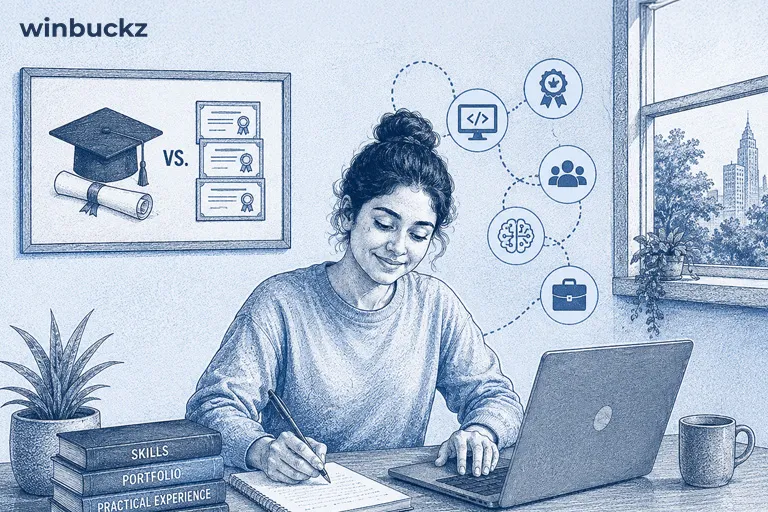
Technology is evolving rapidly. Entire industries are transforming within a few years, and new roles are appearing faster than traditional education systems can adapt. Employers are increasingly focused on practical skills, real-world experience, and continuous learning rather than academic credentials alone.
As a result, microcredentials are among the most talked-about trends in education and professional development. Alongside online bootcamps, specialized training programs, and online certifications, they are creating alternative pathways for people who want to learn faster, spend less, and enter high-demand industries with relevant skills.
The question is no longer whether degrees matter. The real question is whether they are the only route to career success. And with learning courses, you surely can ace up your game.
Why Skills Are Becoming the New Currency
A university degree still carries significant value. Many professions continue to require formal qualifications, and higher education remains an important foundation for millions of careers.
But in today’s world, companies have realized that their employees work in industries where skills can quickly become obsolete. The industries of cybersecurity, software engineering, artificial intelligence, digital marketing, and data analysis demand people who continue learning throughout their professional life.
Hence, the demand for micro-credentials has been increasing. Microcredentials provide deep knowledge in a particular skill, rather than the broad knowledge obtained from years of schooling.
For employers, these qualifications often demonstrate a highly valuable ability: learning, adapting, and staying current with industry trends.
In a workplace where change is constant, that adaptability can be just as important as a traditional degree.
The Growing Popularity of Micro-Credentials
Flexibility is one of the biggest benefits of these short programs. Many professionals cannot afford to leave their jobs and return to full-time education. Shorter learning programs allow them to gain new skills while continuing to work and earn an income.
Micro-credentials tend to be more practice-focused than traditional credentials. Learners develop specific knowledge, skills, and work practices that can be instantly implemented in the workplace.
This is why many professionals are turning to professional certification programs and online certifications when seeking promotions, salary increases, or career changes.
Rather than replacing degrees entirely, these qualifications often complement existing education by helping professionals remain competitive in a rapidly changing economy.
Why Are Online Bootcamps Attracting Career Changers?
Of all the education trends, few have risen as rapidly as that of online bootcamps.
Once reserved for tech and coding jobs, bootcamps can now be found teaching a range of subjects, from user experience to digital marketing. The key attraction of the bootcamp is its practical nature. Rather than relying on extensive theoretical knowledge, much emphasis is placed on practical application.
For people looking to switch careers, career bootcamps offer a particularly attractive option. Someone working in retail, hospitality, administration, or customer service can often gain industry-specific skills within months rather than years.
Such a format not only appeals to trainees but also provides them with opportunities to achieve specific goals. In fact, many bootcamps are designed with employment in mind, giving trainees an opportunity to build their portfolios.
With talent shortages continuing to plague various industries, such alternative education methods become more applicable.
How Is Kaplan Adapting to Modern Learning?
As demand for flexible education grows, established learning providers are evolving alongside it.
Over the years, Kaplan has earned a reputation for its exam preparation training. At present, Kaplan’s online training not only helps individuals prepare for exams but has also expanded into various courses that offer learners career growth opportunities through online learning.
One advantage of online learning is its convenience. Working professionals can study wherever they choose, according to their own schedule, and pursue qualifications in subjects relevant to them.
This is another reason why micro-credentials have continued to attract many learners seeking practical knowledge without investing much time.
The Princeton Review and the Evolution of Education
Another organization adapting to changing learner expectations is The Princeton Review.
For decades, Princeton Review test prep has been associated with helping students prepare for important academic milestones. However, growing interest in Princeton Review online courses reflects a broader shift toward digital learning environments.
Online education is no longer viewed as a secondary option. For many learners, it has become the preferred way to acquire new skills and qualifications.
The success of providers such as The Princeton Review highlights how education is becoming increasingly accessible. Geographic location, work schedules, and personal commitments are no longer the barriers they once were.
Specialized Learning for Professional Careers
There are, of course, certain jobs that require specific training and certification, but. In this instance, customized education can be a vital component towards a person’s career advancement.
This is the area in which companies like BARBRI which specifically offers legal education have built up a solid reputation. Known for its certification training, the company specializes in professional development.
The expansion of BARBRI career programs reflects a wider trend across professional industries. Learning is no longer something people complete at the start of their careers. Instead, it has become an ongoing process that continues throughout working life.
There is an increasing trend for professionals to acquire specialist knowledge to remain competitive, deepen their expertise, and meet new industry needs. And so, if as a law student you must check 7 law school final exam study tips to study smarter.
The Future of Education Is Continuous Learning
The rise of microcredentials, online bootcamps, and professional certification programs does not necessarily mean traditional degrees are disappearing.
Instead, education is becoming more flexible and personalized.
Today, many professionals hold a combination of qualifications, certifications, boot camps, and various trainings in addition to their academic qualifications. Today, organizations are not focused solely on qualifications; they are also looking at other aspects.
In a world where industries change rapidly, the most valuable qualification may not be a degree earned once. It may be the willingness to keep learning.
That is why micro-credentials and bootcamps are gaining momentum. They provide professionals with a faster, more targeted way to acquire relevant skills and stay prepared for whatever comes next.
FAQs
They are highly sought after by employers because they provide evidence of certain skills, industry expertise, and lifelong learning.
Bootcamps focus on practical, job-ready skills and are usually completed much faster than traditional academic programs.
Relevant certifications can strengthen a professional profile and may improve opportunities for promotions, career advancement, or industry transitions.
Career bootcamps are great for individuals seeking to switch to a new career path or refresh or brush up on current skills in a short time.
Not necessarily. Many professionals use these alongside degrees to build specialized expertise and remain competitive in their field.