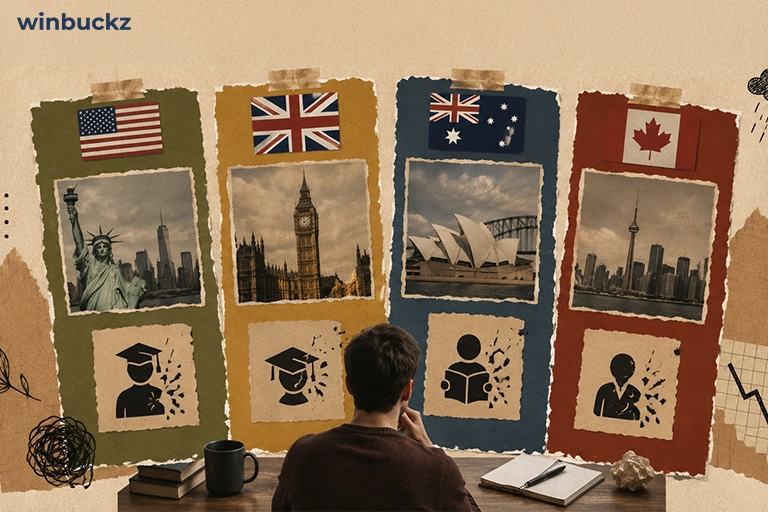
For decades, global higher education operated on a highly predictable map. If you had the grades and the capital, your path led directly to the traditional academic strongholds: the United States, the United Kingdom, Australia, or Canada. These destinations held a virtual monopoly on the international student experience, promising world-class campus life and a golden ticket to global career mobility. They were undisputed as the best countries to study abroad.
But in 2026, that map is completely fracturing.
Recent data reveals an unprecedented enrollment winter hitting these traditional markets. The gateways are closing, driven by aggressive immigration crackdowns, strict caps, and skyrocketing expenses. Let’s look at why the tides of global talent migration are shifting away from the West and how it is changing the landscape for international applicants.
The Perfect Storm: Policy, Price, and Precarity
The current crisis didn’t happen overnight, but a series of sharp policy changes has accelerated the decline across the Big Four. To understand why they are slipping from their status as the best countries to study abroad, we have to look at the shifting frameworks:
- Canada: Dropped its accelerated Student Direct Stream (SDS) visa processing and enacted strict caps on study permits.
- The UK: Banned postgraduate taught students from bringing family dependents and shortened post-study work timelines.
- Australia: Drastically increased student visa application fees and banned onshore visa flipping.
- The US: Deeper administrative scrutiny and rising visa denial rates have severely dampened student interest.
When you pair these restrictive pipelines with the soaring cost of studying abroad, exacerbated by high inflation and stringent proof-of-funds requirements, the financial equation simply stops making sense for middle-class families. The historical heavyweights are actively losing their competitive edge.
The Rise of Shifting Horizons: Study Abroad Alternatives
As the Big Four tighten their borders, the fundamental desire for world-class learning hasn’t vanished; it has simply shifted geographic coordinates. Students are aggressively seeking viable study abroad alternatives that offer high-quality degrees without hostile immigration policies.
Continental Europe and the Asia-Pacific region are capturing this massive wave of displaced talent, quickly becoming the new best countries to study abroad. Countries such as Germany, France, Ireland, and Spain have reported double-digit increases in international student applications.
As they map out these evolving pathways, prospective students are increasingly looking beyond basic university brochures. To evaluate long-term opportunities, many rely on advanced digital tools. For instance, exploring a region’s historical ties and ancestral heritage through a comprehensive genealogy and demographic platform like the MyHeritage research platform can give families unique insights into cultural integration. Leveraging a specialized MyHeritage family history education strategy helps students map deep-rooted ancestral connections to specific nations, which can heavily influence where they feel most supported as they build a new life.
Changing Ecosystems: The Digital and Alternate Education Boom
The disruption of traditional brick-and-mortar pathways has permanently accelerated fundamental higher education trends. The modern student is realizing that the physical campus model is no longer the exclusive gatekeeper to a high-paying global career, radically expanding the definition of education accessibility.
This friction has fueled a massive boom in hyper-accessible, remote alternatives across two distinct fronts:
1. Flexible Independent Skill Building
Independent educators and field experts are bypassing institutional red tape entirely by launching targeted, self-paced masterclasses. Using robust platforms like Podia, creators can build custom digital academies that provide direct, practical industry skills. The frictionless nature of Podia’s means specialized professionals can update curricula in real time, giving students actionable knowledge instantly applicable to the global job market at a fraction of the cost of university tuition.
2. Verified Institutional and Corporate Credentials
For those still seeking institutional prestige, macro-learning ecosystems have completely redefined access to education. Platforms leading the charge provide a powerful alternative to traditional immigration:
| Learning Route | Core Dynamics | Final Outcome |
| Traditional Student Visa | High upfront tuition, skyrocketing living expenses, and tightening visa restrictions. | High Financial Risk |
| Coursera Online Learning | Remote, scalable learning modules from elite, Ivy League universities. | Verified Career Mobility |
Students can access rigorous coursework from elite Ivy League universities and top global institutions, all from their home countries. Rather than risking thousands of dollars on a volatile visa process, a student can earn fully verified Coursera professional certificates or enroll in complete, accredited Coursera online degrees. These digital pathways deliver the exact same corporate recognition and skill verification as a physical degree, completely insulated from fluctuating border policies.
The Verdict: A Fragmented Future
The golden era of the Big Four’s undisputed academic dominance is officially drawing to a close. While top-tier legacy institutions will always attract elite applicants, the mass market of international education has permanently decentralized. In 2026, the value of an education is no longer measured by the physical stamp in a passport, but by the flexibility, affordability, and practical utility of the skills acquired.
For students willing to pivot, the best countries to study abroad are now the ones that prioritize transparency, reasonable costs, and clear paths to professional success. If you are looking for alternative pathways, tracking study abroad options, or investing in flexible learning modules, finding the right digital tools is your next best step.
If you are looking to pivot your career, acquire cutting-edge technical skills, or invest in highly flexible learning modules without taking on massive institutional debt, take a moment to explore our curated collection of vouchers inside the services and education index. It is a highly strategic, low-risk way to access premium educational tools and professional certifications at an exceptional value.
Frequently Asked Questions
Germany, Ireland, and New Zealand currently offer the most welcoming post-study work frameworks with fewer visa restrictions.
Focus on earning verified professional certificates backed by top tech giants like Google, IBM, or Microsoft to prove real-world skill proficiency to remote employers.
The government cut the SDS program to actively reduce the number of temporary residents and tighten overall financial vetting for incoming students.
Yes, researching your ancestral history can reveal verified familial ties that may open the door to ancestral citizenship or specialized heritage visas.
Podia courses are built by independent experts for quick, hyper-practical skills, while Coursera provides macro-level corporate and academic tracks recognized by traditional HR departments.