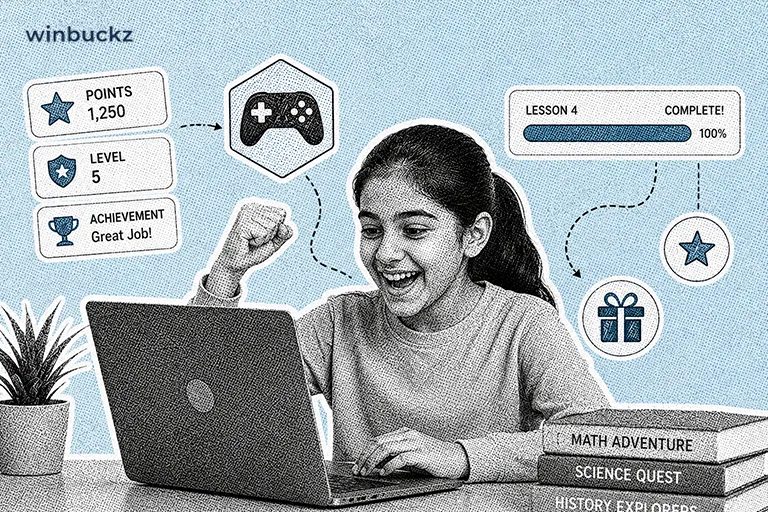
It’s not about making it an arcade or swiping out books for video games. It’s about bringing the mental aspect that makes games so engaging to environments where students have traditionally not been able to engage.
The Engagement Problem Nobody Wants to Admit
Traditional education has an attention problem. Lectures work for some learners and completely fail others. Standardized assessments measure performance on a single day under specific conditions. And passive consumption of information, sitting, listening, reading, and hoping it sticks, is one of the least effective ways humans actually retain knowledge.
Gamification in education does not fix the curriculum. It fixes the relationship between the learner and the material. When progress is visible, when effort is immediately rewarded, and when failure carries no permanent consequence, people engage differently. They try again. They push further. They stay longer.
This is not a theory. It is the same psychology behind why someone will spend three hours solving a puzzle they chose and forty minutes resisting a task they were assigned.
What Does Gamification in Education Actually Look Like?
The word is overused and is almost lost in translation. A leaderboard stapled onto a quiz is not gamification. A badge for handing in homework is not “gamification.” These are on top of the same passive experience, and it is easy for learners to see them through.
Education gamification is the integration of game elements in the learning process itself. The mechanics that consistently produce results share four characteristics.
Immediate feedback:
Traditional education makes students wait days for the grade. Gamified learning responds instantly. All attempts have an immediate response that the learner can act on. This is what game-based education does that passive learning formats can’t do.
Progressive difficulty:
A good game never presents its most difficult challenge to the novice. The level of difficulty increases with demonstrated competence. This structure is borrowed for educational gamification so that learners are always at the edge of their current capabilities, challenged, and driven to continue until they reach the next level.
Visible progress:
Completion bars, skill trees, streaks, and experience points all serve the same function. They make invisible growth tangible. Visualizing progress is very motivating when learners can observe it directly, rather than see it in a gradebook.
Meaningful autonomy:
The best gamified classrooms allow the learner to have some choice in what they do. Next Module To Be Tackled? Next Challenge To Take? Next Skill To Learn? In all learning contexts, student autonomy is a key factor in sustaining student engagement.
Difference Between Traditional Learning and Gamification In Learning
| Traditional learning | Gamified learning |
| Delayed feedback through grades | Immediate feedback after every attempt |
| Fixed linear curriculum | Flexible progression paths |
| Pass or fail assessment | Multiple attempts with no permanent penalty |
| Passive content consumption | Active participation and decision making |
| External motivation through marks | Internal motivation through progress and reward |
The Online Learning Platforms Actually Doing This Well
This is where the conversation gets more interesting, because the online learning platforms that do game-based education well are not always the ones people expect.
Duolingo is the most cited example for good reason. It built an entire language learning product around streaks, experience points, hearts, and level progression. Critically, the game mechanics are not cosmetic. They are load-bearing. Remove them, and the product falls apart. Duolingo’s completion rates sit measurably above traditional language course averages, and that gap is directly attributable to how the gamification is structured rather than bolted on.
Kahoot turned classroom quizzing into a live, competitive game and, in doing so, created one of the most widely adopted interactive learning tools in formal education globally. The competitive element is real-time, the feedback is instant, and the energy in a room during a Kahoot session looks nothing like that of a room sitting through a traditional quiz.
Quizlet took flashcard revision, one of the driest study formats imaginable, and rebuilt it around game modes, match challenges, and progress tracking. The result is a platform that students voluntarily return to, which is the clearest possible signal that the gamification of learning mechanics is working.
Classcraft (Gamifylist)goes furthest by turning the entire classroom experience into a role-playing game. Students build characters, earn experience points through positive academic behaviors, and face collaborative challenges as a team. It is the most ambitious application of game-based education at the classroom level and, when implemented well, produces measurable improvements in behavior and engagement.
What all four share is the same underlying principle. The game mechanics serve the learning outcome. They are not decorations. They are structured.
Science That Explains Why It Works
Gamification in learning isn’t an intuitive trend. Based on research in cognitive science.
It is stimulated by dopamine at the neurological level. Dopamine is released in the brain both when it expects a reward and when it receives one. Both moments are repeated throughout a learning session by the game mechanics engineer. Each right answer, each level achieved, and each streak maintained creates a genuine neurological response, supporting further engagement.
Spaced repetition is very natural for game-based learning. By incorporating previously learned skills into increasingly difficult tasks, the sequence in which the games present these skills is similar to spacing, one of the most well-documented learning methods in the literature. Retrieval practice occurs without drill experience for learners.
One of the most important cognitive changes gamification brings about is failure reframing. In the conventional learning model, the inability to learn has social, academic, and psychological implications. When in a ‘game’ setting, failure is just a call to action to try again. This eliminates the avoidance response that makes challenging content very difficult to connect with in usual environments.
Final Thoughts
Gamification in education works because it addresses the root of all learning issues. Ensuring the presence, involvement, and return of people. Whether in terms of effectiveness, engagement, or retention, game-based education beats all passive educational alternatives every time the mechanics are designed to accomplish real learning goals.
The classroom does not have to look like a game to function like one. It simply needs to make progress feel real, failure feel safe, and effort feel worthwhile to continue making. If you’re interested in finding online learning deals and education software specials, promo codes, and deals, we’ve got you covered with the latest special offers in one place; you can get started without paying full price.
Frequently Asked Questions:
1. So, what is gamification in the education system?
The use of game design principles, such as points, levels, streaks, and instant feedback, in learning contexts engages learners and enhances knowledge acquisition.
2. Are game-based education and gamification the same?
Not exactly. Game-based education is education through real games. Gamification uses game mechanics in a content area that is not a game. Both aim to enhance interactive learning over passive learning.
3. Does the use of gamification in learning actually have a positive impact on outcomes?
It is consistently demonstrated that when mechanics are structurally embedded rather than cosmetically applied, time on task, completion rates, and retention increase.
4. Where is gamification most effective?
Some of the most popular examples of gamification in learning at scale are Duolingo for language studies, Kahoot for classroom engagement, Quizlet for revision, and Classcraft for full classroom gamification.
5. Is learning through gamification appropriate for every age group?
The mechanics differ by age group, but the main ideas are the same from childhood to adulthood: professional development.